Removing Trespassers from Commercial Property in BC: What the Law Allows
Removing Trespassers from Commercial Property in BC: What the Law Allows
Written by Paul Thandi, Operations Manager, On Guard Security Ltd. — 10+ years in BC security · Updated September 2026
Most BC business owners have had to deal with an unwanted person on their property at some point. It might be someone sleeping in a loading bay or a person who keeps coming back after being asked to leave. Removing trespassers in BC is mostly done with notice, clear direction and documentation, not force. This guide covers what the Trespass Act allows, how to post signs and give notice properly, what you and your security guards can and can't do, when to call police, and how to prevent the problem in the first place.
This article is general information about BC law as published, not legal advice. For a specific situation, speak with a lawyer or your local police.
Key takeaways
Under the BC Trespass Act, a person who has been told to leave, orally or in writing, commits an offence if they don't leave as soon as practicable or if they come back.
Signs count as notice when they are clearly visible and legible from each ordinary point of access. Properly posted land counts as "enclosed land" under the Act.
An owner can authorize a security company to act for them. That lets a guard give notice, direct someone to leave, and ask for their name and address.
The Trespass Act's arrest power belongs to peace officers. Security guards have no police powers, so in practice they direct, document and call police.
The Criminal Code allows only force that is "reasonable in the circumstances" to remove someone from property. Calm words almost always work better and are far safer for everyone.
The main law is the provincial Trespass Act. It centres on the occupier of premises, which means the person entitled to control the property or who is responsible for it. That can include a tenant or property manager, not just the registered owner. The Act also recognises an authorized person: someone the occupier has authorized to exercise the occupier's powers under the Act. A security company working under contract for a property is usually acting as that authorized person.
Section 2 of the Act sets out three ways a person commits trespass:
Entering enclosed land. This includes land surrounded by a lawful fence or natural boundary, and land posted with signs that prohibit trespass. Anyone found on enclosed land is presumed to be there without consent.
Entering after notice from the occupier or an authorized person that entry is prohibited.
Doing a prohibited activity after notice, such as overnight parking.
The Act also makes it an offence not to leave, or not to stop an activity, "as soon as practicable" after being directed to, or to come back after being told to leave. Section 3 sets out the defences: a person is not guilty if they had the occupier's consent, other lawful authority, or "colour of right" (an honest belief that they were entitled to be there).
Trespass under this Act is a provincial offence, not a crime under the Criminal Code. That affects who can arrest for it, as covered below.
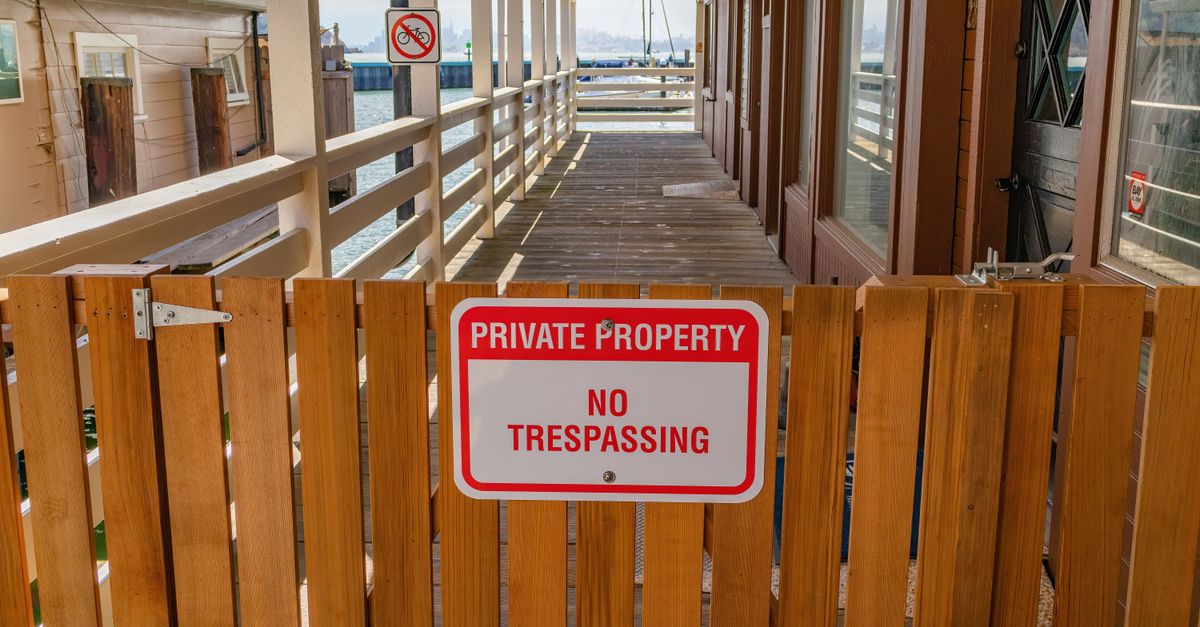
Most of the work of removing trespassers happens before anyone arrives, through notice. Section 4 of the Act allows notice orally, in writing, or by a sign posted at or near an ordinary point of access that is clearly visible, with legible writing, from the approach in daylight and normal weather.
The Act also says:
A sign showing an activity with an oblique line through it counts as notice that the activity is prohibited.
Notice can apply to all or part of a property. You can prohibit entry to a loading dock and leave the storefront open to customers.
Only the occupier or an authorized person may remove, alter or deface these signs. Anyone else who does commits an offence.
In practice, put a lit, readable sign at every driveway, gate, lane and path, and say plainly if the rules differ by area or time.
Key insight: good signs do most of the work. When the property's rules are posted clearly at every entrance, a guard only has to point to the sign and ask the person to leave, and there is rarely any argument.
Once someone has been told to leave, the Act does most of the work. A direction from the occupier or an authorized person to leave or stop an activity can be oral or written. If the person doesn't comply as soon as practicable, or comes back, they commit an offence. Section 6 adds that when the occupier or authorized person has reasonable grounds to believe someone is trespassing, or has trespassed, that person must give their correct name and address on demand. Refusing is a separate offence.
How you ask matters as much as what the law says. We train officers to:
Say who they are and who they work for, explain the rule in plain words, and ask the person to leave.
Allow reasonable time to collect belongings, stay calm and keep a safe distance.
Record the time, the direction given and the response.
Many people on commercial property at night aren't there to cause harm; some are sheltering because they have nowhere else to go. When removing trespassers, a respectful approach usually gets a quicker result and keeps everyone safer.
The Criminal Code has a defence for this situation. Section 35 (defence of property) says a person is not guilty of an offence when, believing on reasonable grounds that they are in peaceable possession of property or acting under the authority of the person who is, they act to prevent someone entering without legal right or to remove them. The act must be "reasonable in the circumstances".
This defence is judged after the fact, by police, prosecutors and possibly a court, based on everything that happened. It is not a general right to use force. Pushing someone out of a doorway can quickly turn a trespass problem into an assault complaint, an injury or a lawsuit.
Key insight: having a legal defence doesn't make force a good plan. If someone refuses to leave, the safest option is usually to step back, document what happened and call police, not to take hold of them.
A licensed security guard acting for the occupier has the same trespass powers as the occupier, and no more. Guards are not peace officers and have no police powers. Section 7 of the Trespass Act gives the power to arrest without a warrant for trespass to peace officers. The Criminal Code's general arrest power (section 494) lets any person, including an owner or someone the owner authorizes, arrest a person they find committing a criminal offence on or in relation to the property. The arrested person must then be handed to a peace officer "forthwith". Simple trespass under the provincial Act isn't a criminal offence, so in most trespass situations the guard's job is to direct, document and call police.
A guard acting for the occupier can
A guard cannot
Give notice that entry or an activity is prohibited
Arrest someone for trespass under the Trespass Act. That power belongs to peace officers.
Direct a person to leave or to stop an activity
Use more force than is reasonable in the circumstances
Ask for a name and address when there are reasonable grounds to believe the person is trespassing
Present themselves as police or act as though they have police powers
Observe, record and report incidents, and give their notes to police
Wear a police-style uniform or carry an identification badge (Security Services Regulation s.12)
Call police and stay to meet them
Carry handcuffs or other restraints unless the registrar has authorized it (Regulation s.11)
Arrest a person found committing a criminal offence on the property (Criminal Code s.494), then hand them to police right away
Hold someone and wait to deal with them later. Anyone they arrest must go to a peace officer right away.
The equipment and uniform limits come from the Security Services Regulation. That's also why we staff trespass calls with trained, unarmed security guards whose job is to calm things down, not to escalate.
Call 911 if anyone is in danger, if there is violence or a weapon, a fire, a medical emergency or a break-in in progress.
Call your local police non-emergency line if someone refuses to leave after being told, keeps coming back, or gives a false name, and no one is in immediate danger.
Call your security provider to give notice, check the property after hours and keep the record behind any police report.
For sites with after-hours problems in lots, lanes or loading bays, GPS-tracked mobile patrol gives regular, documented visits without the cost of a full-time guard.
Removing trespassers who keep coming back depends on records. An incident report should record the date, time and exact location, a description of the person, what was said, whether they left, and whether police were called, including any file number. Photos of the signs at each entrance also help show that notice was given properly.
Records show police a pattern, show you where and when problems happen, and support you if a conviction follows. Under section 8 of the Trespass Act, the Provincial Court can order someone convicted of trespass to pay restitution for the damage or loss they caused.
Prevention is cheaper and kinder than removing trespassers again and again. What works best on commercial property:
Lighting at entrances, lanes, loading bays and parking areas.
Access control: doors that close and lock, gates on loading areas and parkades, and no propped doors.
Clear signs at every ordinary point of access, as described above.
Site layout: clear alcoves and hiding spots, and secure dumpster areas.
A visible presence: a patrol or guard at the hours problems happen.
Cameras help with evidence but work best alongside people who can respond. For retail plazas, offices and mixed-use sites, our commercial security services combine these measures into a plan that fits your hours and your budget. For lots and parkades specifically, see our parking lot security.
Get help with your property
On Guard Security Ltd. has worked with Lower Mainland businesses and property managers for more than 10 years from our Surrey office. Our officers are licensed and JIBC-trained, and we're WorkSafeBC compliant, fully insured and staffed 24/7. We'll walk your site, check your signs and access points, and recommend the least intrusive coverage that works. Call 778-990-5070 or request a consultation.
Can you physically remove someone from your property in Canada?
The Criminal Code (section 35) provides a defence for acts done to prevent someone entering, or to remove them from, property you peaceably possess or act for, but only if the act is reasonable in the circumstances. The defence is judged after the fact. In practice, directing the person to leave, documenting what happened and calling police is safer and carries less legal risk than using force.
How to keep unwanted people off your property?
Post clear, lit signs at every ordinary point of access, improve lighting, secure doors, gates and loading areas, remove sheltered hiding spots, and provide a visible presence through a guard or scheduled mobile patrol at the hours problems happen. Handle every incident the same respectful way and keep written records.
What are the trespass laws in BC?
The main law is the provincial Trespass Act. It is an offence to enter enclosed land, to enter or do a prohibited activity after notice from the occupier or an authorized person, and to fail to leave as soon as practicable after being told to, or to come back. Notice can be given orally, in writing or with properly posted signs. Trespassers must give their name and address when asked. Peace officers can arrest without a warrant for trespass.
How to scare off trespassers?
Deterrence works better than intimidation. Good lighting, clear signs, secured access points and a regular, visible security presence make a property less attractive to trespassers. Threats or aggressive tactics can put people at risk and expose you to legal liability, so avoid them.
Can a security guard arrest a trespasser in BC?
Generally, no. The Trespass Act gives the power to arrest without a warrant for trespass to peace officers, and security guards are not peace officers. The Criminal Code lets any person, including someone authorized by the owner, arrest a person found committing a criminal offence on the property, but simple trespass under the provincial Act isn't a criminal offence. A guard's role is to give notice, direct the person to leave, record what happens and call police.
What should a no trespassing sign say in BC?
The Trespass Act doesn't prescribe exact wording. It requires signs to be clearly visible from the approach to each ordinary point of access, with legible writing, in daylight and normal weather. A sign showing an activity with an oblique line through it counts as notice that the activity is prohibited. Keep the wording plain, and say if the rule applies only to part of the property or at certain times.
Google Review
Jack Willson
A pleasure to recommend company On Guard Security; mostly I enjoyed their quality services and effective response. They understand our security needs and able to ensure the best possible or professional services. Team members were professional, friendly experienced and highly approachable and live up to our expectations.
Google Review
James Cook
On guard security is my preferred choice when I need reliable security services. The team and professional service are unmatched. Their security guards and overall security are really dedicated. Recommend them for any security guard or private protection services!
Google Review
Patrick Parker
The reason I called on guard security is because they are local. They did not waste any time from the first phone call. I greatly appreciate the professionalism, service, and peace of mind offered by this security company.
Google Review
Thomas Chase
I was experiencing many incidences of shoplifting at my store and so I hired On Guard Security to provide professional guards. They did a fantastic job and now my business and merchandise are fully protected.
Google Review
Jon Wiltz
I was looking for a reliable and affordable security company for my clothing store and On Guard Security Ltd have done a fantastic job! I would definitely recommend them to fellow small business owners.
Google Review
Alan Cooper
I am happy with the performance of On Guard Security Staff assigned to our facilities. The guards respond quickly to needs and questions. I would definitely recommend this security company to others.
Google Review
~CrystalStarHomesLtd.
The guards were friendly and very cooperative. Excellent services with prices you can’t turn down. I had 24 hours security patrol on all sites. I would recommend OnGuard Security to anyone who’s looking for security services . Thanks so much Rajan really appreciate your services looking forward to meet again!
Google Review
~Jovan Dhillon
Very respectful staff, staff got to my site on time. Would book again
Google Review
~Aman Johal
I would highly recommend On Guard Security. We hired them for my brothers wedding and they provided great service. The staff always showed up on time.
Google Review
~Jason Powell
We used On Guard for our building while we were transitioning to our new intercom and entry system. They were always incredibly professional to deal with and the guards showed up well ahead of time and did a great job as we went through the process, which extended longer than expected. On Guard was also great at getting somebody on site the first night we needed them on very short notice. Overall, we were extremely happy with their service.
Google Review
~Balraj Malhi
Very good company to work with on gaurd ” Rajan is very proffesional and so are the guards. I would definetly reccomend On Guard security”Always Treat like a Famliy
Google Review
~kiran sohal
I hired on guard for my sisters wedding this past weekend, the guards were there 15 minutes early and made sure everything went smoothly , definitely will hire again
Google Review
~Sukh Brar
Provided an excellent service with my wedding events last week!! Very professional team of workers. Will definitely call for on guard’s services for future needs.