Types of Security Guards: Static, Mobile Patrol, Concierge, Event and More
Types of Security Guards: Static, Mobile Patrol, Concierge, Event and More
Written by Paul Thandi, Operations Manager, On Guard Security Ltd. — 10+ years in BC security · Updated September 2026
When property managers call us, they often ask for "a guard" without knowing there are several very different kinds. A static security guard who stays at one site all shift does a different job from a mobile patrol officer covering ten properties a night, and both differ from a concierge at a condo front desk. Picking the wrong type means paying for coverage you don't need, or leaving gaps where you do. This guide explains the main types of security guards in BC, what each one does, where each fits best, and how to decide.
Key takeaways
A static security guard is stationed at one property for the whole shift, providing constant presence, access control and foot patrols of that site.
Mobile patrol guards visit several properties by vehicle, checking each at intervals. It costs less than a full-time guard but isn't continuous.
Concierge, event, loss prevention, fire watch, construction site and alarm response guards are specialised versions of the same licensed role.
In BC, all of these roles fall under the same "security guard" licence type in the Security Services Regulation. The difference is training, post orders and supervision.
Most properties are best served by a mix, for example a static guard in business hours and mobile patrol overnight.
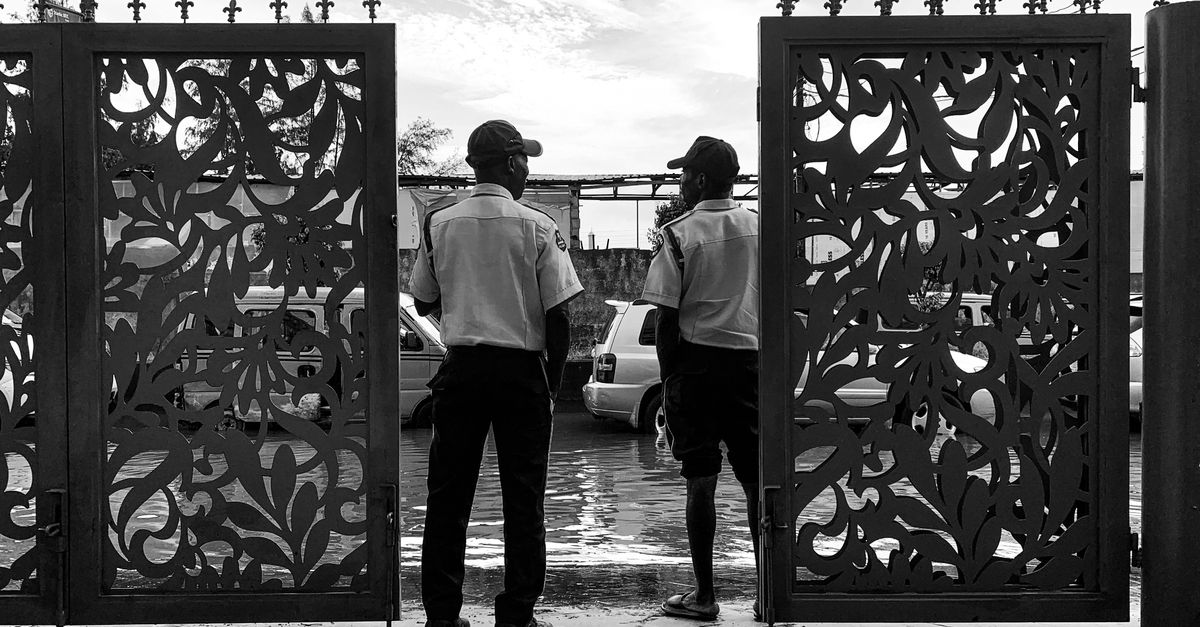
A static security guard, sometimes called a stationary or on-site guard, is assigned to one property for an entire shift. They may sit at a lobby desk, staff a gate or loading dock, or work from a site office, and they do regular foot patrols of the property between those duties. The key word is presence: someone is always there.
The responsibilities of a static security guard are set by the client's post orders, but usually include:
Access control: checking who enters, signing in visitors and contractors, issuing passes and keeping unauthorised people out.
Foot patrols of the building, parkade, perimeter and high-risk areas, checking doors, lighting and equipment.
Observing and reporting suspicious activity, safety hazards and maintenance problems such as leaks or broken locks.
Responding to incidents within their authority: calling police, fire or ambulance, helping during evacuations and preserving the scene.
Documenting everything in daily activity reports and incident reports for the client.
Customer service: giving directions, helping staff and visitors, and being a calm point of contact.
A static security guard makes sense wherever a constant presence is worth the cost: offices and corporate buildings, warehouses and industrial sites with valuable stock, hotels, hospitals, construction sites during high-risk phases, and any site where access control has to happen at a specific point. Our commercial security guards work this way.
Key insight: The main thing a static security guard gives you is continuous coverage. If your biggest risk is someone walking in unnoticed, you need a person at the door, not a patrol that passes by every few hours.
A mobile patrol guard drives a marked security vehicle between several client properties on a route, stopping at each to check the perimeter, doors, parking areas and anything specific in the client's instructions. Visits can be scheduled or randomised so the pattern is hard to predict. Mobile patrol guards also lock and unlock buildings, attend alarms and deal with issues such as trespassing or open doors.
Because one guard covers many sites, mobile patrol usually costs less than a full-time static guard. The trade-off is that nobody is on site between visits. It suits retail plazas and parking lots after hours, vacant buildings, strata complexes that need overnight checks, and businesses that want a visible presence without a full shift. Our GPS-tracked mobile patrol records each visit so clients can see when their property was checked.
A concierge security guard is a static guard with a stronger customer-service role. They staff the front desk of a condo, apartment or office tower, greet residents and visitors, manage deliveries and parcels, monitor cameras and access systems, and respond to building issues. They're still security: they control who gets in, patrol common areas and report incidents. But how they deal with people matters as much as how observant they are. See our condo concierge security service for how this works in residential buildings.
Event security guards work for a fixed period at weddings, corporate functions, festivals, private parties and community events. Their duties include checking tickets or guest lists at entry, managing crowds and queues, watching for intoxicated or disruptive guests, protecting gifts and equipment, and helping with first aid calls and evacuations. The number of guards depends on the guest count, the venue, whether alcohol is served and how many entrances there are. Learn more about our private event security.
Retail loss prevention guards deter and detect theft in stores, malls and plazas. Some work in uniform at the entrance as a visible deterrent; others are plain-clothes loss prevention officers who watch the sales floor. BC's security guard licence type specifically includes loss-prevention services.
Fire watch guards
Fire watch guards patrol a building on a strict schedule while its fire alarm or sprinkler system is out of service, or while hot work is under way. They look for smoke, heat and hazards, raise the alarm if needed, and keep a timed patrol log for the fire department and insurer.
Construction site guards
Construction site guards protect materials, tools and heavy equipment on sites that are hard to secure. They often combine static coverage at night and on weekends with patrols of the site perimeter, and they may also cover fire watch during hot work.
Alarm response guards
When a monitored alarm is triggered after hours, an alarm response guard attends the property, checks it, secures any open doors or windows, contacts the keyholder and reports back. The BC security guard licence explicitly covers monitoring or responding to alarms on someone else's property.
Whatever the type, every guard working for a BC security company has to meet the same provincial rules. The Security Services Regulation sets one "security guard" licence type that covers guard services, including loss prevention, and monitoring or responding to alarms. That means a static security guard, a patrol officer and a concierge hold the same kind of licence.
The Regulation also sets rules clients can see for themselves:
Uniforms must show the word "SECURITY" on the chest and on the back of any jacket or vest worn, plus the employer's name, and must not resemble a police uniform. Guards may not carry an identification badge.
Patrol vehicles must display "SECURITY" on both sides and the security company's name and phone number, and can't have sirens or police-style light bars. A client can request an unmarked vehicle in writing, subject to the registrar's approval.
Equipment is restricted. Guards can't carry restraining devices unless the registrar has authorised it, or any weapon prohibited by the Criminal Code.
Key insight: Since all guard types hold the same licence, the difference between a good concierge and a good static security guard comes from site training, clear post orders and supervision. Ask any provider how they prepare a guard for your specific site.
Do you need someone there all the time? If access control or immediate response matters every hour, you need a static security guard or concierge. If periodic checks are enough, mobile patrol is more economical.
Who will the guard deal with most? Residents and visitors point to concierge. Shoppers point to loss prevention. Contractors and deliveries point to a static guard at the gate.
When is the risk highest? Many sites need a static guard during business hours and mobile patrol overnight, or the reverse.
Is it temporary? Fire watch, events and construction phases are time-limited, and coverage can be scaled up or down.
Cost follows the choice. Static, concierge, event and fire watch coverage are billed hourly per guard, so the number of guards and hours drives the total. Mobile patrol is usually priced per visit or as a monthly plan, and alarm response per call-out. For typical rate ranges, see our guide to security guard costs in BC.
On Guard Security Ltd. has provided static, mobile patrol, concierge, event, loss prevention, fire watch and construction site security across the Lower Mainland for more than 10 years. Our guards are licensed and JIBC-trained, and every new officer completes a week of one-on-one training with a senior officer before working alone. We're WorkSafeBC compliant, fully insured and available 24/7 from our Surrey office, serving Surrey, Vancouver, Richmond, Burnaby, Langley, Abbotsford and the Fraser Valley.
A static security guard is a licensed guard assigned to one property for an entire shift. They staff a fixed post such as a lobby, gate or loading dock, control access, patrol the site on foot and report incidents, giving the property a constant security presence.
What are the responsibilities of a static security guard?
Typical responsibilities are access control, signing in visitors and contractors, foot patrols of the building and perimeter, observing and reporting suspicious activity and hazards, responding to incidents by calling emergency services, and writing daily activity and incident reports. The client's post orders set the exact duties.
What are the four types of security guards?
There's no official list of four. The most common types are static (on-site) guards, mobile patrol guards, concierge or front-desk guards, and event guards. Loss prevention, fire watch, construction site and alarm response guards are specialised roles. In BC, all of them hold the same security guard licence type.
What are security guard services?
Security guard services are the protection a licensed security company provides using trained guards. Under BC's Security Services Act, a security guard service includes guarding or patrolling property, guarding an individual, preventing the loss of property, and providing door security at liquor-licensed establishments.
How much does a security guard cost for a day?
A day of coverage is priced as hourly rate multiplied by guard-hours, so it depends on how many hours you need, how many guards, the type of guard, the site's risk, and whether the shift falls on nights, weekends or statutory holidays. Short bookings may carry a minimum shift length. We quote on the specific site and schedule.
What is the hourly rate of a security guard?
The hourly rate varies with the type of guard, site risk, required experience, contract length, how much notice you give and the time of day or week. Contract length and minimum shift lengths can also affect the rate. Mobile patrol is often priced per visit instead. Our BC security guard cost guide explains the rate factors in more detail.
Google Review
Jack Willson
A pleasure to recommend company On Guard Security; mostly I enjoyed their quality services and effective response. They understand our security needs and able to ensure the best possible or professional services. Team members were professional, friendly experienced and highly approachable and live up to our expectations.
Google Review
James Cook
On guard security is my preferred choice when I need reliable security services. The team and professional service are unmatched. Their security guards and overall security are really dedicated. Recommend them for any security guard or private protection services!
Google Review
Patrick Parker
The reason I called on guard security is because they are local. They did not waste any time from the first phone call. I greatly appreciate the professionalism, service, and peace of mind offered by this security company.
Google Review
Thomas Chase
I was experiencing many incidences of shoplifting at my store and so I hired On Guard Security to provide professional guards. They did a fantastic job and now my business and merchandise are fully protected.
Google Review
Jon Wiltz
I was looking for a reliable and affordable security company for my clothing store and On Guard Security Ltd have done a fantastic job! I would definitely recommend them to fellow small business owners.
Google Review
Alan Cooper
I am happy with the performance of On Guard Security Staff assigned to our facilities. The guards respond quickly to needs and questions. I would definitely recommend this security company to others.
Google Review
~CrystalStarHomesLtd.
The guards were friendly and very cooperative. Excellent services with prices you can’t turn down. I had 24 hours security patrol on all sites. I would recommend OnGuard Security to anyone who’s looking for security services . Thanks so much Rajan really appreciate your services looking forward to meet again!
Google Review
~Jovan Dhillon
Very respectful staff, staff got to my site on time. Would book again
Google Review
~Aman Johal
I would highly recommend On Guard Security. We hired them for my brothers wedding and they provided great service. The staff always showed up on time.
Google Review
~Jason Powell
We used On Guard for our building while we were transitioning to our new intercom and entry system. They were always incredibly professional to deal with and the guards showed up well ahead of time and did a great job as we went through the process, which extended longer than expected. On Guard was also great at getting somebody on site the first night we needed them on very short notice. Overall, we were extremely happy with their service.
Google Review
~Balraj Malhi
Very good company to work with on gaurd ” Rajan is very proffesional and so are the guards. I would definetly reccomend On Guard security”Always Treat like a Famliy
Google Review
~kiran sohal
I hired on guard for my sisters wedding this past weekend, the guards were there 15 minutes early and made sure everything went smoothly , definitely will hire again
Google Review
~Sukh Brar
Provided an excellent service with my wedding events last week!! Very professional team of workers. Will definitely call for on guard’s services for future needs.