
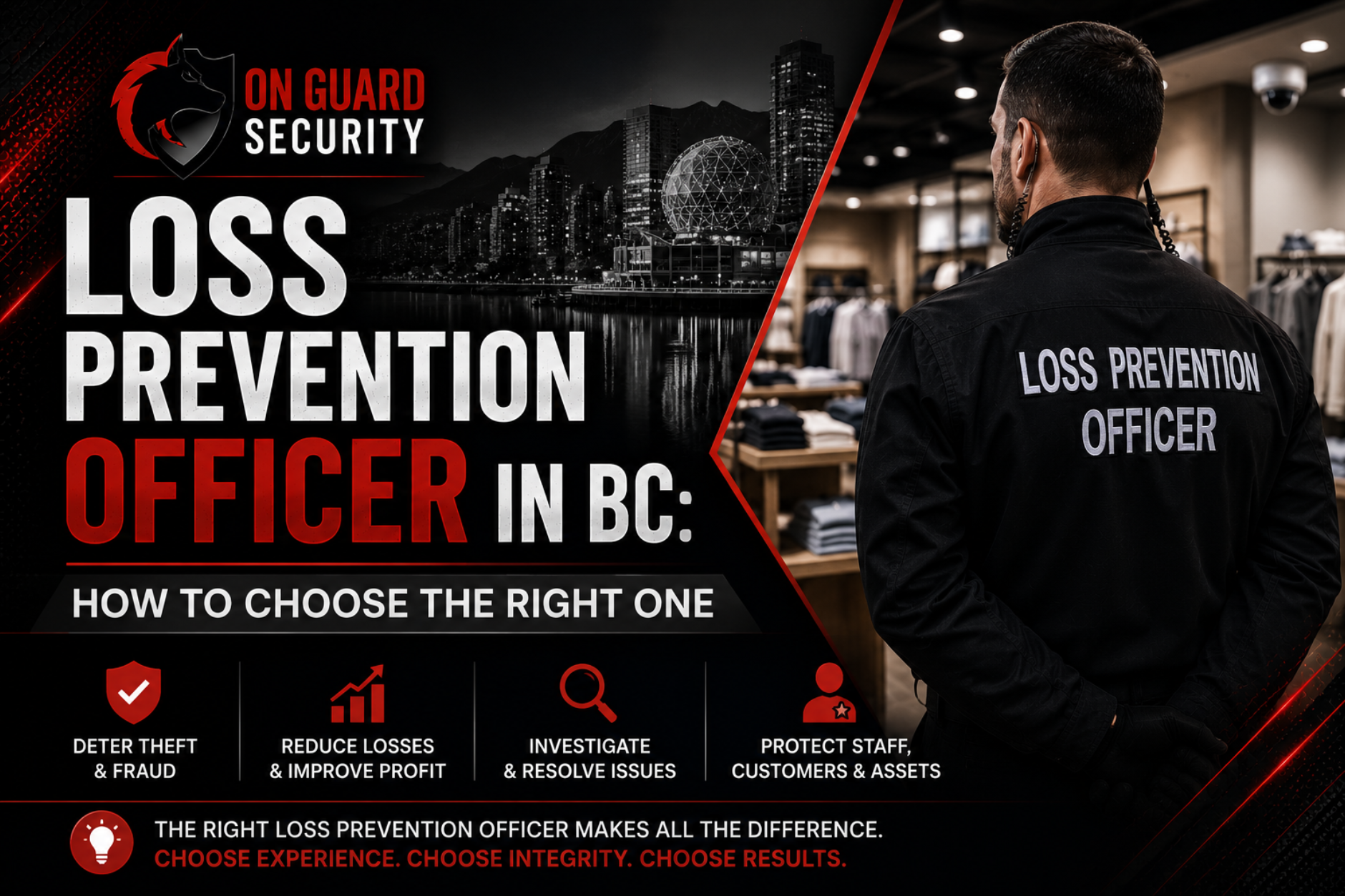
Retail Council of Canada estimates Canadian retailers lose roughly $5 billion every year to shrink — and roughly a third of that comes from internal theft, not shoplifters. A trained loss prevention officer is the single most cost-effective way to cut those losses, but only if you hire the right one. This guide shows BC property managers, store owners, and facility leaders exactly what to look for.
Key Takeaways
- A qualified loss prevention officer in BC must hold a valid Security Worker Licence issued by the Ministry of Public Safety and Solicitor General after JIBC-approved training.
- Expect hourly rates between $24 and $38 in the Lower Mainland, depending on uniform style (overt vs. plainclothes) and risk profile.
- The best officers reduce shrink by 25–40% within the first 90 days through observation, documentation, and lawful arrest procedures — not aggressive confrontation.
- Always verify licensing, WorkSafeBC coverage, incident reporting standards, and a written use-of-force policy before signing a contract.
A loss prevention officer is a licensed security professional whose specific job is to detect, deter, and document theft, fraud, and inventory shrink inside retail and commercial properties. In British Columbia, they must hold a Security Worker Licence under the Security Services Act and complete Justice Institute of British Columbia (JIBC) Basic Security Training before working a shift.
Unlike a general guard who patrols a perimeter, a loss prevention officer focuses on people and product flow. They watch fitting rooms, monitor point-of-sale activity, review CCTV, and build evidence packages that hold up under Crown review. Some work overtly in uniform; others work in plainclothes to blend in with shoppers.
For a deeper view of how this role fits within broader loss prevention services, the duties extend beyond catching shoplifters — they shape policies that prevent theft from happening in the first place.
A loss prevention officer in BC observes customer and employee behaviour, documents suspicious activity, makes lawful citizen’s arrests under section 494 of the Criminal Code, conducts CCTV reviews, and writes detailed incident reports. They also audit inventory shrink data, train staff on theft-prevention procedures, and liaise with local RCMP detachments when files move to prosecution.
A typical shift blends three activities: surveillance, intervention, and reporting. Strong officers spend 70% of their time observing — not chasing. Confrontation is always the last step, never the first.
| Function | What it looks like | Outcome |
|---|---|---|
| Surveillance | Floor walks, CCTV monitoring, fitting-room watches | Theft deterred before it occurs |
| Apprehension | Lawful detention under PPRA & Criminal Code s.494 | Recovery of merchandise, charges laid |
| Documentation | Notebook entries, video logs, witness statements | Court-ready evidence |
| Audit support | Cycle counts, POS exception reports | Internal theft identified |
Every loss prevention officer working in British Columbia must hold a Security Worker Licence issued by the Security Programs Division of the Ministry of Public Safety and Solicitor General. The licence requires completion of the 40-hour JIBC Basic Security Training course, a clean criminal record check, and renewal every five years.
On Guard goes further. Every new officer completes one full week of one-on-one training with a senior officer before working independently, covering Criminal Code authority, evidence handling, de-escalation, and PIPA-compliant CCTV use.
If you’re verifying credentials yourself, our guides on security licence in BC and renewing security license bc walk through exactly what a valid licence looks like and how to confirm it’s current.
Key insight: Ask any provider to show you the BC Security Worker Licence number for every officer assigned to your site — legitimate companies share this on request.
Uniformed loss prevention officers deter opportunistic theft and reassure customers, making them ideal for big-box retail, grocery, and pharmacy. Plainclothes officers are better suited to apparel, electronics, and liquor stores where organized retail crime is the main concern. Many BC retailers use a blended model — one visible officer at the entrance and one undercover on the floor.
The choice depends on what you’re losing and to whom. Visible deterrence stops first-time and opportunistic shoplifters. Covert observation catches repeat offenders, booster crews, and dishonest employees who already know where the cameras point.
| Format | Best for | Limitation |
|---|---|---|
| Uniformed | Grocery, big-box, malls, plazas | Less effective on professional thieves |
| Plainclothes | Apparel, electronics, liquor, pharmacy | Lower deterrent value |
| Blended | High-shrink urban locations | Higher hourly investment |
In British Columbia, contracted loss prevention officers typically cost $24 to $38 per hour in 2026, depending on uniform style, risk level, and shift length. Plainclothes and bilingual officers sit at the upper end. Most retailers in Surrey, Vancouver, and Burnaby budget $4,000 to $7,500 monthly for a single full-time officer covering peak hours.
Cost isn’t just the hourly rate. Factor in supervision, scheduling backup for sick days, statutory holiday premiums, and equipment such as body-worn cameras or radios. Contracted providers fold those into one transparent rate, which is why most BC retailers prefer them over in-house staffing.
For a full breakdown across guard types, see our security guard cost guide.
By the numbers: Retail Council of Canada (2024) reports shrink at 1.33% of retail sales nationally — for a store doing $4M annually, that’s $53,200 a year walking out the door.
Most BC retailers under $25M in annual sales find contracted loss prevention more cost-effective than in-house teams. Contracting eliminates payroll administration, WorkSafeBC overhead, vacation coverage, and training costs. In-house only pays off above roughly 3,000 monthly LP hours, when you also need a dedicated investigations manager on your books.
There’s also the liability question. When a contracted officer makes an arrest, the security company’s $5M commercial general liability policy responds first. With in-house staff, your business carries that exposure directly.
Property managers running multiple sites often pair loss prevention with property management security and mobile patrol security under one contract for cleaner reporting and lower total cost.
Ask seven questions before signing: Are all officers JIBC-trained and Security Worker licensed? Is the company WorkSafeBC compliant with $5M+ liability? What’s the average officer tenure? Will the same officers cover my site weekly? What reporting platform do you use? What’s your response time to alarm calls? Can you provide three local references in my industry?
Tenure matters more than headcount. An officer who’s worked your store for six months knows your regular customers, your staff schedule, and the faces of repeat offenders. A revolving door of new faces resets the deterrent value to zero every shift.
For a broader comparison framework, our guide to security companies in BC walks through evaluation criteria in detail, and our list of hiring security firm mistakes covers the red flags to avoid.
Key insight: A reputable BC provider will hand over a written use-of-force policy, an incident reporting sample, and proof of WorkSafeBC standing within 48 hours of your request.
Retail leads the list, but warehousing, distribution, hospitality, and healthcare all benefit from dedicated loss prevention officers. High-target sectors in BC include grocery, liquor, cannabis retail, consumer electronics, fashion apparel, and pharmacy. Logistics operators in Surrey, Delta, and Richmond increasingly hire LP officers to monitor dock theft and pallet-level shrink.
The pattern is consistent: any business handling high-velocity, easily resold goods sees measurable ROI within the first quarter. Retailers running our retail loss prevention program in Surrey have documented shrink reductions between 25% and 40% in the first 90 days.
For warehouse operators concerned with inventory leakage, our guide on warehouse security importance covers the operational case for dedicated LP staff on the dock floor.
Bottom line: If your shrink rate is above 1% of sales, a single trained loss prevention officer typically pays for themselves within the first 60 days of placement.
On Guard Security Ltd. has provided JIBC-licensed loss prevention officers across Surrey, Vancouver, Burnaby, Langley, and the Fraser Valley since 2014. We’re locally owned, WorkSafeBC compliant, and available 24/7 — not a faceless national chain. Every officer completes one week of one-on-one training with a senior officer before stepping onto your floor.
If you’re losing inventory you can’t explain, you don’t need fear marketing — you need a trained set of eyes on your floor. Call 778-990-5070, email info@onguardsecurityltd.ca, or visit onguardsecurityltd.ca to book a free walk-through of your site this week.
Copyright © 2019. - All Rights Reserved